Beyond ChatGPT: A Professor-Built AI for Business School
Custom generative AI agents deepen learning of marketing

Artificial intelligence has moved from campus curiosity to classroom co-pilot in record time. Across higher education and especially in business school, faculty are experimenting with ways to move beyond generic chatbots toward course-specific, purpose-built AI that deepens learning rather than shortcuts it.
The early adopters aren’t using AI to replace rigor; they’re using it to scale access to it.
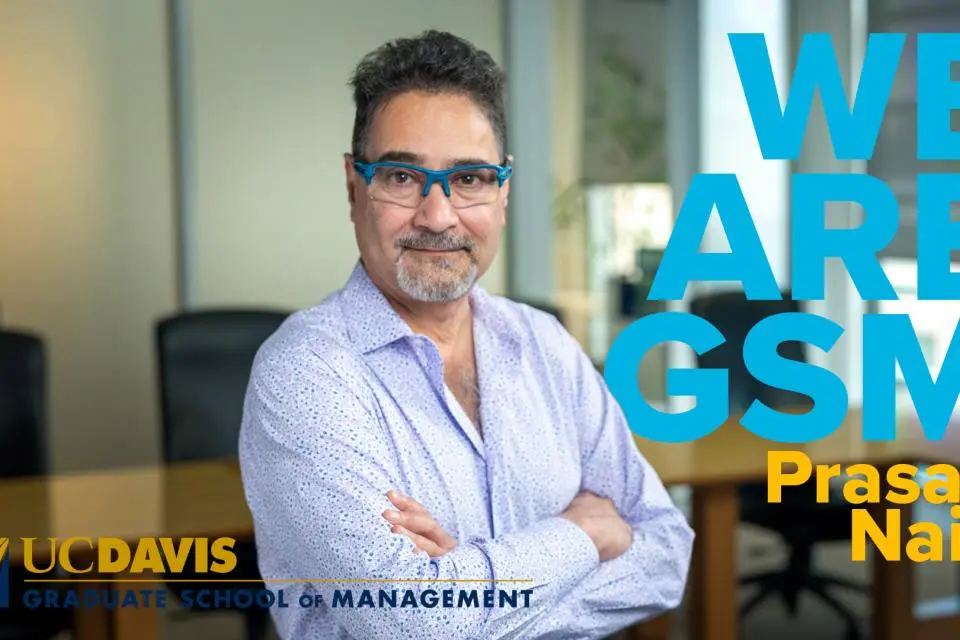
At the UC Davis Graduate School of Management, Professor Prasad Naik has been on the forefront of doing exactly that.
A leading scholar in marketing analytics and quantitative modeling, Naik has built two customized AI agents—Ask Athena for his MBA marketing course and Ask Gauss for his Master of Science in Business Analytics class. These aren’t open-ended, internet-scraping bots.
These AI agents are carefully designed, course-embedded learning tools trained on his own syllabus, lecture notes, cases and frameworks. Available 24/7, they function as personalized teaching assistants that answer queries and prompts in real time, generating practice quizzes and reinforcing enduring principles rather than chasing fleeting headlines.
At an inflection point where business education is being reshaped by GenAI, Naik’s approach offers a practical blueprint: use the technology to enhance mastery, extend faculty expertise and give students on-demand access to structured, high-quality guidance.
We sat down with Professor Naik to talk about why he built his own AI agents, how students are using them and what this signals for the future of business education.
Can you share how you have been incorporating customized GenAI tools into your courses?
I created Ask Athena as my AI agent to answer students' questions in my MBA marketing course. It answers questions on the syllabus (e.g., when's the exam, what's the exam format, what's the grading rubric, and so on), on the course content (e.g., what is XYZ, how do I apply XYZ in practice, why do we need to know XYZ, and so on), and so on. I do exclude current affairs and news because they are ephemeral facts and not enduring principles.
I have developed Ask Gauss for my MSBA course. It's the same idea as Ask Athena, except the content is math and stats rather than marketing.
Did you develop/build the Ask Athena AI tool yourself or was it adapted from an existing app?
Yes, I built Ask Athena. Having said that, I acknowledge that everything is built on everything that's available thus far. For example, computers could be built because electricity and transistors were available. And electricity could be built because calculus was available. And so on. In that spirit, marketing knowledge is available to me based not only on my own programmatic research, but also cumulative research developed by generations of my academic forebears.
Similarly, many companies now implement large language models (LLM) developed by machine learning scholars. I use the NotebookLM tool from Google that productized the LLM knowledge. Then I populate it with the content (e.g., syllabus, cases, lecture notes, and so on) for my course. A couple of years ago, Ask Athena was born—ready to add further value to our MBA students 24/7.
What can students ask about the courses using the LLM?
Students can ask any marketing-related questions such as how to launch new products, segment markets, position the product, analyze the competition, how to decide on pricing, traditional advertising, digital advertising, social media advertising, consumer promotions, trade promotions, and so on.
They can also ask questions about the syllabus, exams, location, timing, the format (e.g., are notes and books allowed in exams), and so on. Even skeptical questions like “what's the point of learning this or that content?” Practically any questions they would ask me, TAs, friends or critics. The Ask Athena answers these questions in a few seconds, at any time of the day, on any device (i.e., mobile, laptops), from any location (i.e., in class, out of class, while doing homework in teams, at work during break).
How have students responded? Do they like being able to get quicker answers?
Students love it, I think, because the responses are in real time, but more importantly because they love the interactive nature of Q&As that considers the flow of previous Q&As.
Are students performing better in the courses because of it?
I think so. They learn on their own time when they want it and from where they want it. For example, they can ask and get answers on their lunch break at work or while watching Netflix show. They can even Ask Athena to create quizzes for them to practice from an exam point-of-view rather than from knowledge-for-knowledge's sake.
How much time would you estimate the AI tool has saved you?
The time savings come from not needing to answer multiple versions of the questions that are somewhat similar, but from various students on different occasions. Ask Athena tailors the answers to different students based on the flow of a specific student's specific train of thought. This personalization is of great value to students and time-savings for me.
With the speed of advancement in AI technology, what can you foresee how pedagogical AI tools like this will change business/higher education five years from now?
Five years from now, students will have a standard expectation that all courses should come with a personalized teaching assistant tool like Ask Athena. It's just like books on a desk 30 years ago or a syllabus on the web 20 years ago.
Ask Athena goes far beyond the syllabus and books for my core marketing class.
Ask Athena can even provide an audio summary of what a course entails.
Listen to an audio summary of my Marketing Strategy course:
Over time, research will keep advancing the frontiers of knowledge, and personalized teaching will disseminate that knowledge across any device.
Thank you.
Related content

Professor Prasad Naik Recognized with 2023 Don Schultz Award for Innovation in Integrated Marketing Communications
Naik's innovative research and teaching methods to be honored by Medill at a May 25 event

Putting Data Analytics to Work to Improve Agentic AI User Experience
MSBA practicum project gauges user behavior—and how to keep them coming back