Prescribing Innovation: What a Business Mindset Brings to a Healthcare Hackathon
AI solutions earn UC Davis students HackRx 2026 honors
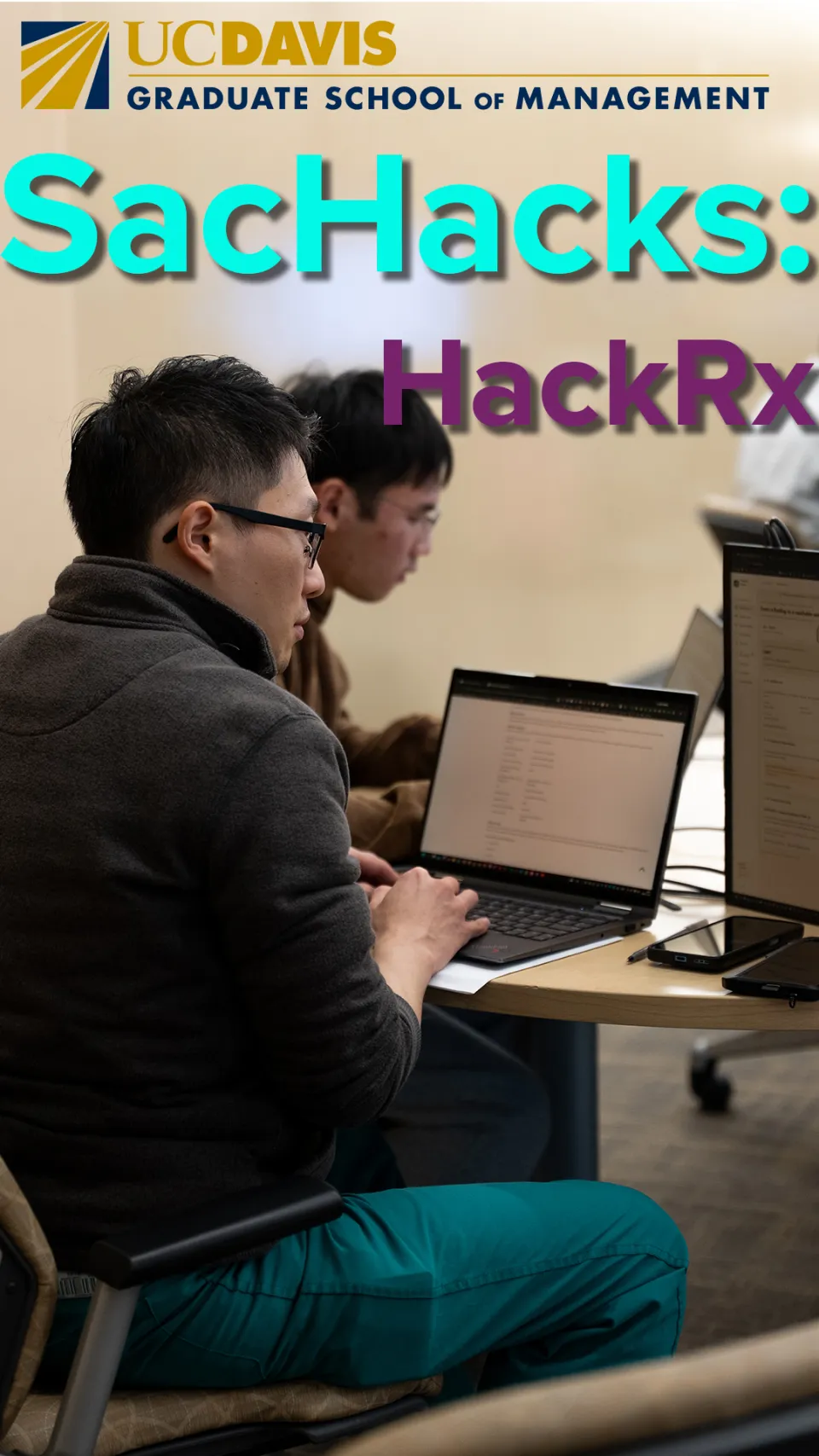
Matching a patient against hundreds of clinical trials by hand can take a few minutes per trial. Aaron Gooch, an Online MBA student at the UC Davis Graduate School of Management, spent a Sunday building a tool that does the scanning automatically.
“I can save potential hours of somebody trying to filter down to find the right trials that they could submit the patient for,” Gooch said of TrialMatchRx. The project won “Best Interdisciplinary Hack” at SacHacks: HackRx 2026.
What is HackRx?
HackRx ran Sunday, Nov. 15, from 9 a.m. to 10 p.m. at Betty Irene Moore Hall on the UC Davis Health Campus in Sacramento. College students and recent graduates, working individually or in teams of up to three, took on one challenge: design technologies, platforms or workflows that advance healthcare, accelerate translational medicine and make biomedical research more efficient or impactful.
SacHacks organized the event with the UC Davis School of Medicine, and GSM shared the event with its students through its communication channels, helping connect business students to a hackathon they might not otherwise consider.
Participants built apps, websites and other tools aimed at problems in medicine, said Jaime Allen, a sponsor from the UC Davis Biomedical Masters of Engineering Program.
Why Business Students Belong in the Room
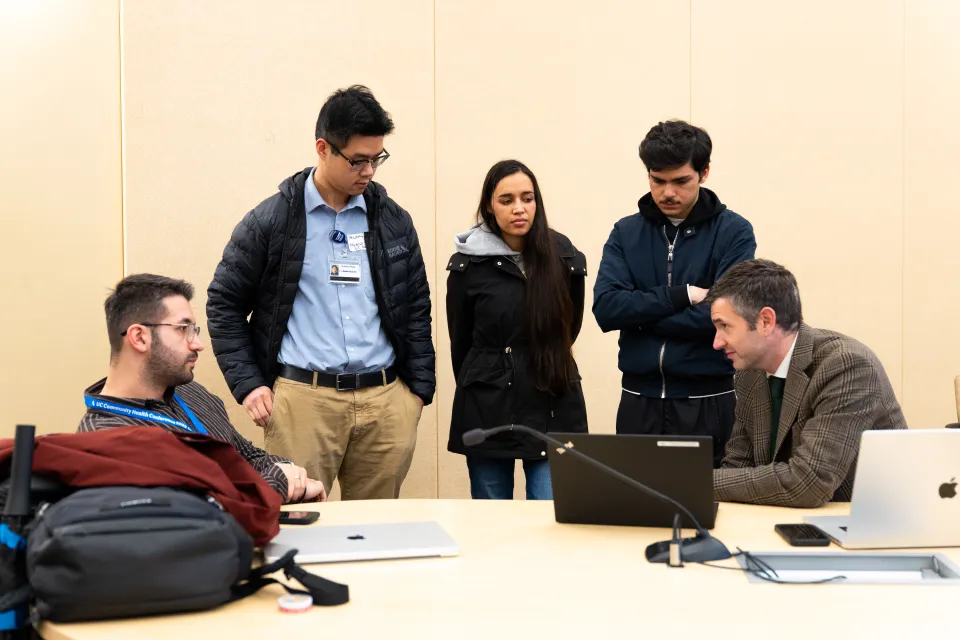
Allen said business training helps teams decide where to aim. “Having the business background of the medical world can be helpful to figure out what ideas are worth pursuing, what needs there are out there that they can address,” she said.
Gooch studied computer science at Northeastern University before coming to GSM, and he expressed that the MBA changed how he approaches a build. It helped him understand “product market fit and generally how businesses approach problems,” and how to apply technology to those problems.
Yosef Meziad, a UC Davis undergraduate double majoring in business and computer science, said his business training shows up in how he starts a project. Meziad’s Triagent AI was another winning project at the hackathon. “I feel like I understand need and finding people, and I feel that is a really important trait when trying to build something, because you need to understand the customer base,” he said.
Judges and mentors described those skills as what makes an idea workable. Devavrat Singh, a computer science Ph.D. student who works with UC Davis and UC Davis Health, said business students can help teams think through how an idea would translate to a real application without losing money. Teams, he said, should present to judges the way they would pitch a business to an investor.
Real Problems, Real People
Teams also worked alongside people who practice medicine. Elizabeth M. Magnan, MD, PhD, a family and community medicine physician, mentored participants by offering clinical context. “They’re all trying to come up with something that could help in a clinical setting, but understanding how it can work is something I can offer as a mentor,” she said.
She expressed the format of the hackathon as part of its value.
“Students get the chance to work on something novel in teams, as well as under a time-constrained environment, which is often how our world works.”
—Elizabeth M. Magnan, MD, PhD, a family and community medicine physician and HackRx 2026 mentor
For Meziad, the day is a starting point. "I really want to explore AI in the medical field,” he said. “I want to do something that is beyond just the hackathon.”
Gooch has advice for GSM students who wonder whether an event like this fits their program. “I think there’s always a fit,” he said. Mentors and sponsors bring real problems they deal with every day, and “a lot of what we are doing in the MBA is problem solving and understanding how to manage people and how to build products so that you can solve problems at scale. So I think whatever you’re doing… there’s always some kind of translation to an event like this.”
Related content

Turning IRS Data Into Real Decisions for Nonprofits
How a UC Davis MSBA team uncovered financial risk and took first place at Aggie Hacks 2026
What Does an AI Engineer Do?
MSBA alumnus Kshitiz Parashar shares insights on compelling, impactful AI career path