Slice of Life: Sacramento Part-Time MBA
Applying MBA skills across finance, advocacy, philanthropy and leadership
What happens when the lessons from your MBA start showing up in your work?
For UC Davis MBA students and alumni, the answer spans industries:
- In banking and finance, classroom insights can shape conversations about raising capital and managing lender relationships.
- In government and public policy, MBA skills can help professionals move into advocacy and work with consumer brands.
- In philanthropy and the nonprofit sector, they can inform multimillion-dollar investments, partnerships and approaches to innovation.
Across those fields, students are also developing skills that travel with them from one industry to another, including analytical thinking, communication, collaboration and people management.
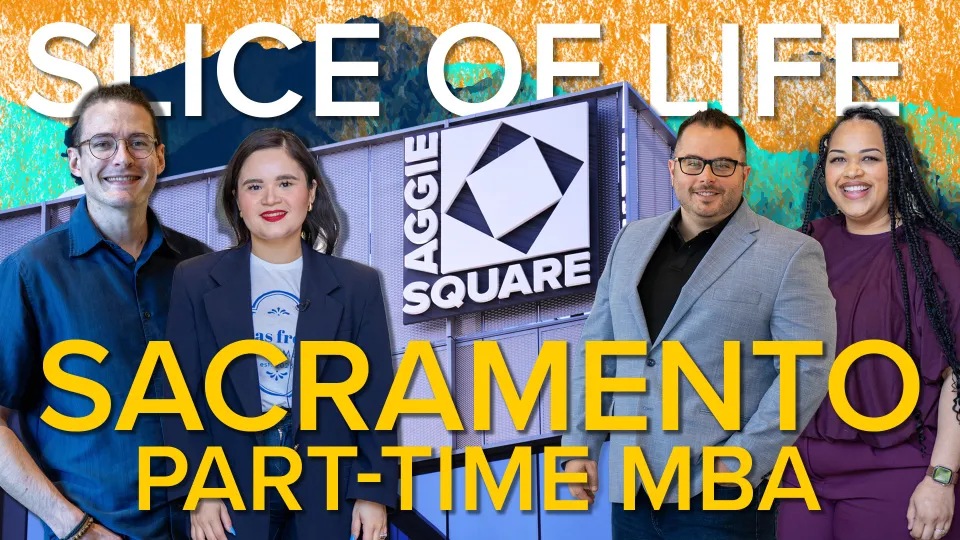
In this Slice of Life, UC Davis Sacramento Part-Time MBA students and faculty share how business education translates into their day-to-day work and prepares them to grow as professionals and leaders.
Video Transcript
Ben Levesque MBA 27
I think a lot of the experience of the faculty members and the professors directly correlates with various industries that directly impact myself. And for instance, the finance professor has over 30 years of experience within the banking world, which oftentimes when it's time to request some funding or additional lending, there's a lot of insight that he's sharing that I could apply on my day to day to either raising capital or just manage a better relationship with my banking system.
The program has a lot of classes, which are very technical, included in my class in finance. But I ask my students when they join the class, share your view on the program. And as you progress through the program, what did you pick up?
What were expected, unexpected, and what's interesting the students point out that technical skills they acquire, but the surprising things to many students is the soft skills they acquire during the program, the networking people management, something that students discovered in this program. And they realize this is maybe as, if not more important than the purely technical skills.
Marisol Ibarra-Bouslama MBA 27
So coming into the program, I was working in the California State Legislature, working in government, shaping policy, but because of the skill sets that I gained through my MBA, I was able to transition now to an advocacy role.
I am a lobbyist here in the greater Sacramento region, and that really allowed me to really understand the business side of things at the GSM and then have my skill set that I already had with policy, and build that bridge and create a niche for me, which allowed me to get this new opportunity.
And I'm very lucky to say that I work with consumer brands, which I did a lot here at the GSM, and I will say that I really got to meet a lot of product managers. So I really understood the products, and now I get to use my skill set from policy to be that bridge and be able to advocate for these brands in front of the state legislature.
Professor Olivier Rubel
When students come here, they basically learn how to think analytically about business problems, whether apply to companies or to non-for-profit organizations. So I just came back from a class teaching how students can use advertising analytics to explore how a blood bank can do better advertising investments, and allocations to bring blood donations to save life.
The other thing that people learn in the GSM is basically how to collaborate with their peers, either with the faculty or with other students working on different group projects from a marketing plan—let's say in my class to other practical projects that they would do through the MBA program or the programs at the GSM.
Sedella Jefferson MBA 27
I serve as the program officer for CARESTAR Foundation, we’re a philanthropic organization and as the program officer, I oversee about a $2.5 million grant making budget that's disbursed across the state of California. And I really feel that the classes within the MBA program have really helped me understand the business, specifically of philanthropy, interestingly enough.
How we make investments, risk on investments, partnerships. And then I would say also internally, I've seen a lot of benefit in terms of how we're working collaboratively within our organization, how we are pushing towards innovation in the ways that we're approaching our grantmaking within the sector. Those are just a couple of the ways that I would say think that the MBA program applies to my current role.
Andrew Rozak MBA 27
Having the initials MBA after your name is going to be nice. But that's really not what it's all about. I would say that it's really growing yourself as a person. Your confidence, your ability to work with people and to communicate ideas. I think all those things are important leadership skills and being able to manage stress, being able to motivate other people towards a shared goal.
I think you just build a lot of relationships and networking through this program. And so it's definitely not just the education itself. Like you're going to have the opportunity to build lasting relationships with people that are going to be able to vouch for you for future career opportunities. And so definitely take advantage of the social events and the mixers. It's a huge benefit of the program along with the great education.
Related content
What's the Difference Between a Part-Time MBA and a Full-Time MBA?
Understanding format, experience and career outcomes for both STEM-designated MBAs

Healthcare and Biotech Careers Offer Strong Growth Paths for MBAs
Alumni at Sutter Health, Synthego and Oncodesign share how business leadership shapes patient care and scientific innovation
How a Part-Time MBA Turns Working Parents into Leaders
Finding my ROI through flexibility, community and purpose