The Statistical Foundation Behind AI, Finance and Modern Business

A new book co-authored by UC Davis Distinguished Professor (Emeritus) Chih-Ling Tsai, explores why covariance remains central to machine learning, finance and modern data science.
Book Quick Facts*:
- Presents a novel covariance-driven approach to incorporate classical and modern techniques together.
- Encompasses cutting-edge skills like dimension reduction, banding, shrinking, penalizing, convolution and transformer.
- Covers covariance regression model, network model, machine learning and covariance matrix, and tensor covariance model.
Artificial intelligence may dominate today’s business headlines, but behind nearly every predictive model, recommendation engine and financial forecast sits a quieter force: the ability to understand relationships within data.
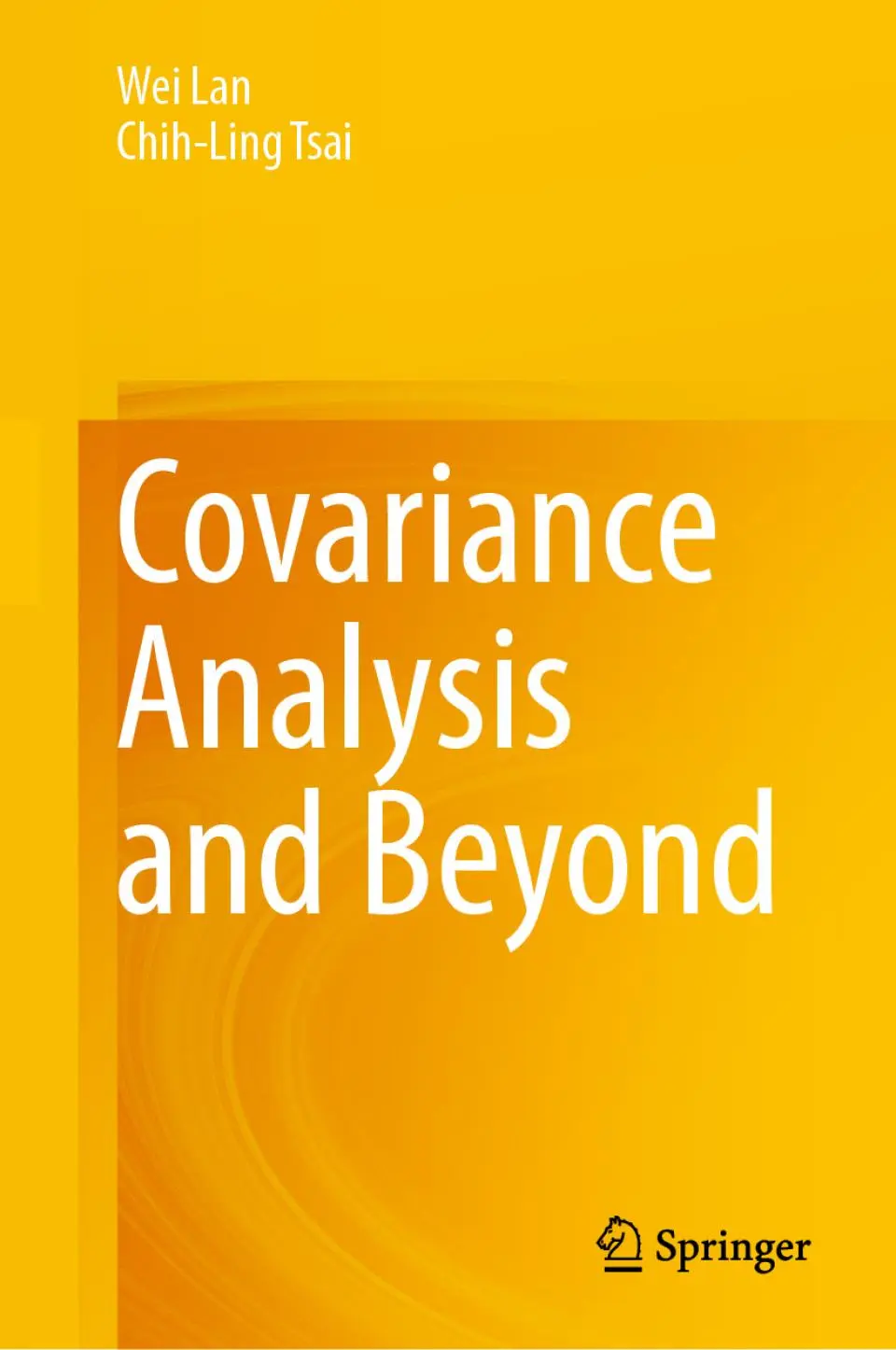
That foundational idea is at the center of a new book, “Covariance Analysis and Beyond,” by UC Davis Graduate School of Management Distinguished Professor (Emeritus) Chih-Ling Tsai and Professor Wei Lan at China’s Southwestern University of Finance and Economics. Published by Springer, the book explores one of the most influential—and often overlooked—concepts in modern data science: covariance.
While the book explores the main concepts in machine learning and AI, Tsai emphasizes that “Covariance Analysis and Beyond” is written primarily for graduate students, researchers and advanced practitioners with quantitative disciplines
The Data Relationships Driving Modern Business
Whether organizations are building AI systems, forecasting markets, optimizing supply chains or understanding consumer behavior, they are ultimately trying to answer the same question: How are variables connected?
Covariance helps analysts understand how different variables move together. In finance, that could mean how stocks rise and fall in relation to one another. In marketing, it might reveal how pricing changes affect customer demand. In AI, covariance structures help models identify patterns inside massive datasets.
Tsai and Lan argue that covariance matrices—mathematical structures used to summarize these relationships across many variables at once—have become central to modern analytics.
And the applications are everywhere.
The authors point to fields including business, finance, engineering, communications, medicine and machine learning as industries increasingly shaped by multivariate data analysis.
That matters because today’s business leaders operate in environments overflowing with interconnected data streams: customer behavior, financial indicators, social media signals, operational metrics and real-time market movements.
The challenge is no longer collecting data. It is understanding the relationships hidden inside it.
Why This Matters in the AI Era
One of the book’s most compelling ideas is that covariance analysis serves as a bridge between classical statistics and modern AI. The authors describe covariance matrices as foundational to innovations in artificial intelligence, big data, machine learning, network analysis and high-dimensional analytics.
Understanding this connection is especially relevant for graduate business students from quantitative disciplines entering a rapidly evolving labor market.
Companies increasingly expect managers and strategists to work fluently alongside data scientists and AI systems. Leaders do not necessarily need to build algorithms themselves, but they do need to understand how analytical systems generate insights, where those systems can fail and how data relationships influence strategic decisions.
This is where statistical literacy becomes one of the leadership skills.
Understanding concepts like covariance helps future executives ask better questions about risk, forecasting, customer segmentation and model reliability. It also creates a stronger foundation for navigating AI responsibly.
Beyond Theory: Real-World Decision Making
What makes the book especially notable is its effort to connect advanced statistical theory with practical application. The authors examine both traditional multivariate methods and newer approaches tied to machine learning, deep learning and network modeling. The goal is to unify classical and emerging analytical techniques under a common framework.
That interdisciplinary approach embodies the current shift toward quantitative training in business education.
At leading graduate business schools, analytics is no longer confined to specialized technical tracks. Data fluency is becoming embedded across finance, marketing, operations, strategy and entrepreneurship curricula.
Students entering today’s workforce will likely manage teams, products and organizations powered by increasingly complex analytical systems. The ability to interpret data relationships and then make decisions and forecasts—rather than simply consume dashboards—may become a major competitive differentiator.
A Timely Contribution from UC Davis
Tsai has long been recognized internationally for his work in statistics, econometrics and data science. His latest book arrives at a moment when AI and analytics are transforming nearly every industry.
But amid the excitement surrounding generative AI and automation, “Covariance Analysis and Beyond” offers an important reminder: The future of intelligent systems still depends on understanding fundamental relationships within data.
Although technology may evolve rapidly, the mathematical principles underneath it remain essential.
And for the next generation of business leaders, understanding how systems work is becoming just as crucial as knowing how to use them.
* Courtesy of Springer Nature Link