Why the Biggest Breakthroughs Happen at the Edges
MBA alumna Smita Madam connects AI innovation with human insight
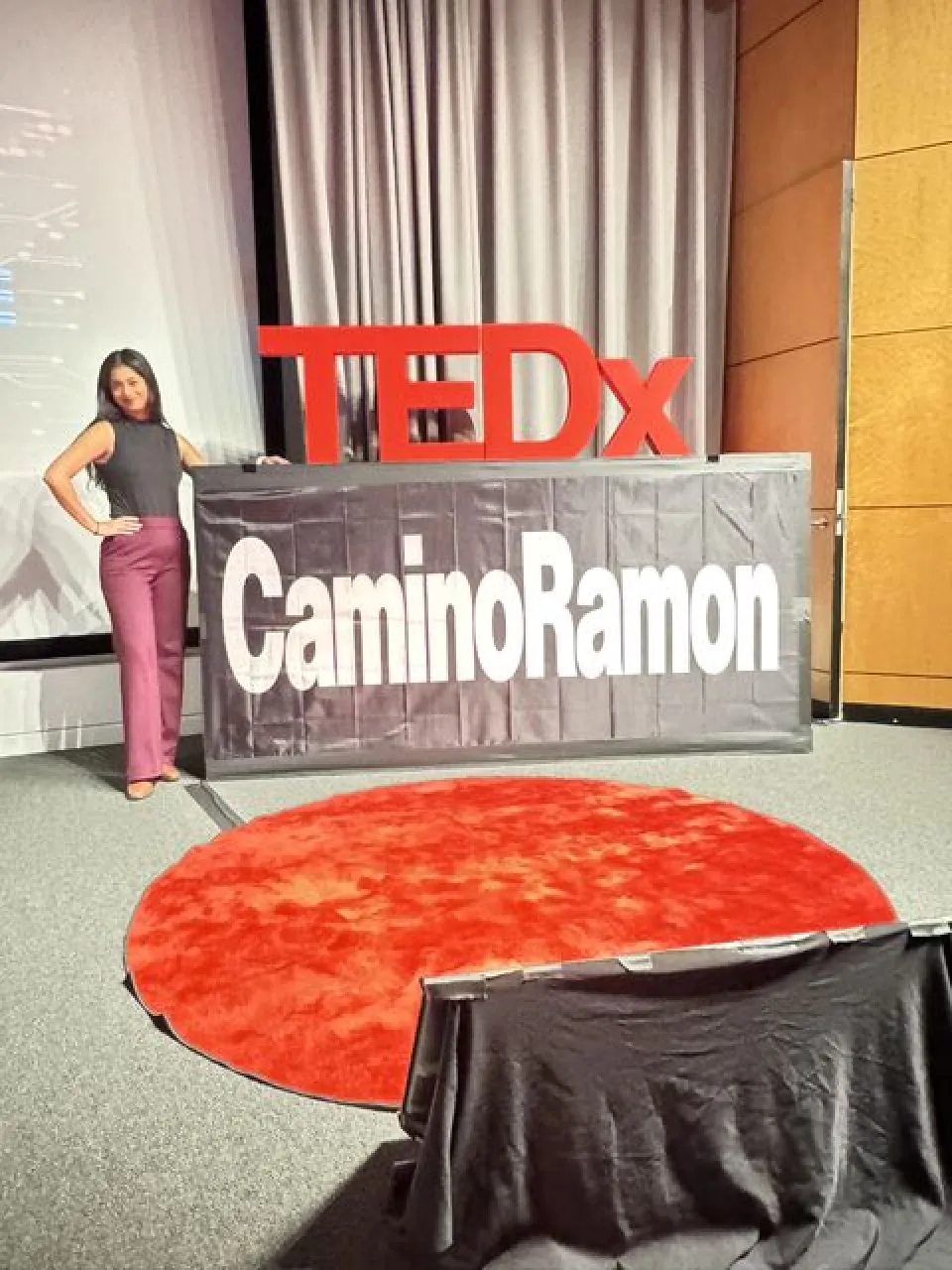
A powerful AI model means little if people don’t trust it. For UC Davis Graduate School of Management alumna Smita Madam, making technology useful requires connecting engineering, design, data and strategy.
In her TEDx talk, “Why the Biggest Breakthroughs Happen at the Edges,” she draws on her product leadership experience and her daughter’s approach to learning to explore how innovation happens where disciplines meet. Below is a transcript of her talk.
Video Transcript
Where did artificial intelligence really come from? It didn’t arrive in a single moment but slowly took shape.
For decades, philosophers asked what it means to think. Neuroscientists studied how the brain learns. Mathematicians searched for patterns. And engineers built faster machines. Separately, each path went only so far. But together, they changed everything.
Artificial intelligence wasn’t invented. It emerged when philosophy, neuroscience, statistics and computing finally collided at scale.
For decades, the progress in each field — AI, biotech, climate and energy — was linear and predictable. Then something shifted, and surprisingly, I saw this happening in my own home.
Little did I know that watching my daughter navigate high school would teach me one of the biggest lessons about convergence.
A New Way of Learning
When I was growing up, subjects lived in neat little boxes: math at 9, bio at 10, art after lunch. And they never talked to each other. But those walls are starting to disappear.
My daughter is a 10th grader, and honestly, AI is her most consistent study partner. She takes a photo of a math problem and asks Gemini to explain it. She uploads slides and asks AI to quiz her.
For her business class, she used AI to create a snack brand, design a logo, choose store locations and even generate music for the ad. I do that in college.
In robotics, she is the designer working with coders and builders to turn ideas into machines. And last summer, for her psychology project at Columbia, she brought together human behavior, market research, statistics and creativity to study the relationship between positive self-appreciation and self-confidence.
That’s when I realized this isn’t just how my daughter is learning. It’s a glimpse of how the next generation will innovate.
The boundaries between subjects are disappearing. AI is now connecting disciplines that once lived in separate boxes. This isn’t an accident. This is convergence in action.
Connecting the Gaps in Medicine
But this wasn’t true a decade ago.
A decade ago, we lost my brother-in-law. In just two years, his journey went from diagnosis to chemotherapy, hospital stays, life support and then death.
A decade ago, it wasn’t that the doctors didn’t care or that the science wasn’t advanced. It was that the system itself was fragmented.
Scans lived in one place, lab results in another. Genetic risk was rarely considered. The doctors were forced to piece together incomplete pictures, relying almost entirely on human eyes and experience.
While early tumors hid in the noise, patterns were easy to miss. By the time the dots connected, the disease had already advanced.
Cancer wasn’t invisible. It was hiding in the gaps between our systems.
Today, cancer detection is being materially improved. We are seeing image analysis accelerate from days to minutes. Cancer is detected at earlier stages, when treatment is more effective, with fewer missed diagnoses.
This progress didn’t come from one breakthrough. It came from convergence, where AI, advanced image analysis, genomics and big data come together.
Where Technology Meets Human Needs
I have seen the same pattern in my own work. The biggest breakthroughs didn’t come from code alone.
In product management in AI, the problems that mattered the most were the ones that required us to bring different worlds together: data, human intuition, design and strategy.
I remember working on a particularly powerful AI model. But here’s the thing: A powerful model is useless if people don’t trust it.
So we had to bring different worlds together. Engineers built the engines. Designers made the experience intuitive and AI outputs easy to understand. And strategy made sure we were building for a real human problem and not just something because we could.
That experience taught me something important. The best moments in my career didn’t come by staying in one lane. They came when I stood at the boundaries, translating what AI could do into something people could actually use, connecting things and turning data and technology into real business impact.
That’s when it clicked for me. Innovation isn’t a straight line. It’s a set of intersections.
The Next Wave of AI Product Management
And this is only the beginning.
In the next wave of AI product management, convergence will deepen even further. AI product managers won’t just manage products. They will become cross-discipline builders.
Imagine you have an AI idea.
A designer asks, “How can you create human-centered AI experiences?”
An engineer asks, “How can I prototype solutions and design system architecture?”
A data scientist asks, “How can I define evaluation metrics, training signals and feedback loops?”
A sales and marketing agent asks, “How can I translate these AI capabilities into clear customer value?”
An operator asks, “How can I define workflows where AI and humans can work together?”
An AI product manager sits in the middle, connecting all of these different perspectives and building one experience that works.
That’s the shift. The best AI product managers of the future will increasingly operate at the intersection of multiple disciplines.
And the most impactful products of the next decade won’t live in isolation on a dashboard. They will emerge when digital intelligence meets the physical and immersive world at the intersection of augmented reality, virtual reality, artificial intelligence, voice, spatial computing and robotics.
The future won’t be shaped by one field, one technology or one type of expert. It will be shaped at the boundaries where AI meets medicine, where biotech meets computing, where art meets engineering.
The Power of Convergence
And this convergence isn’t just an idea. We are already seeing it in the numbers from published research.
AI and biotech are coming together so fast that the market is expected to grow from $4 billion to $11 billion by 2030.
Researchers using AI are discovering 44% more new materials, leading to more discoveries, more patents and more products.
In medicine, AI could potentially cut new drug development time nearly in half.
That means more investments, more discoveries, faster innovation. That is the power of convergence.
Today, the most impactful people aren’t the deepest specialists. They are the integrators, the boundary crossers, the ones fluent in more than one world.
In an age of convergence, edges have become the new center of innovation.
What Two Worlds Can You Connect?
So I want to leave you with a challenge. Ask yourself: What two worlds can I connect that no one else sees? What boundary can I cross? What unique connections can I make?
Don’t just deepen your expertise. Expand the edges of it.
Because breakthroughs don’t come when you stay in your lane. They come when you create new lanes.
The future isn’t built inside silos. It’s built at the meeting points. The messy, vibrant and unpredictable intersections where disciplines collide and reinvent each other.
So if you want to shape what comes next, don’t just stand in one world. Stand at the edges, because that’s where the breakthroughs happen.
Related content
Your MBA, AI and the Future of Work
Microsoft General Manager and alumnus Kiran Bangalore on building skills for what’s next
Preparing AI-fluent MBAs to Navigate and Shape the Future of Business
AI-ready leaders think strategically, creatively and critically about new tech
The Project That Changed How I Think About Data and AI
Inside our practicum project using AI, Python and data analysis for business development